As an Amazon Associate I earn from qualifying purchases. About our affiliate links.
A chocolate with a soft middle gives you a particularly good reason to slow down. The shell breaks, the filling changes the bite, and a small piece can feel quite complete beside the last cup of the evening. Peanut butter, hazelnut, caramel and raspberry each take that pleasure somewhere different.
This selection moves from slender assorted chocolates to nut butter cups, caramel cups and filled dark squares. There are choices for sharing a box and choices for opening one small packet. The useful question is what you want inside the chocolate: a smooth nut filling, a whole hazelnut with chew, or a brighter fruit center.

Start with the center you are looking forward to
A creamy filling and a crunchy nut make different kinds of chocolate treats. Choose the middle first, then think about the chocolate around it and how much you actually want to open.
Nut butter gives a cup or square a dense, yielding center. It stays recognizably nutty without the separate crunch of a whole nut. A caramel cup brings more chew, especially when a hazelnut sits inside it. Raspberry filling offers a softer, fruitier contrast to dark chocolate, with none of the roasted-nut character.
Variety matters in a different way. A mixed box lets the next chocolate be a change; a single-flavor packet keeps the pleasure focused. Merci includes both filled and plain specialties, so it is the broadest choice here. The three Justin’s cups make a more specific comparison between peanut, almond and cashew, while Hu puts hazelnut butter into a chocolate bar.
There is no need to assemble all seven for one sitting. One filling you love is a better starting point than a crowded sweet plate. Add a contrasting piece when you want a change, and let the rest wait for another evening.
Merci Finest Assortment
Chocolate fingers to pass around after dinner.
A 250 g / 8.8 oz box of individually wrapped European chocolate fingers.

Variety in a slender chocolate finger makes Merci an inviting box to share. Milk chocolate, darker specialties and nutty or creamy recipes give the selection more range than a bag of identical filled chocolates.
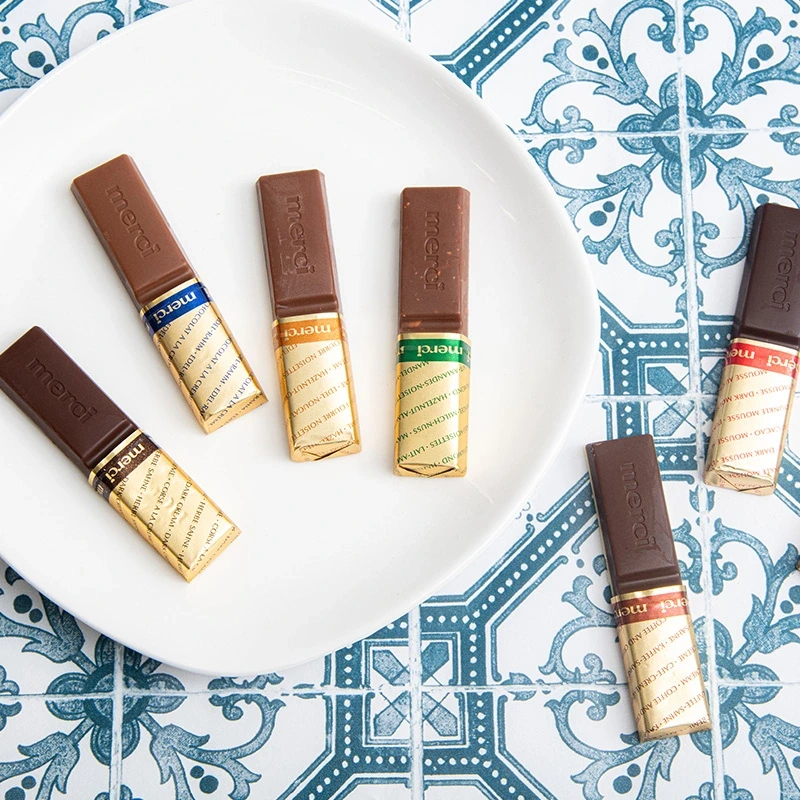
View on AmazonMerci is the sociable choice in this group. The narrow fingers are easy to pass around, and the individual foil wrappers make a small selection feel considered without requiring plates for everybody. A person who prefers milk chocolate can choose differently from somebody who reaches for coffee or a darker cream specialty.
The assortment is more interesting when you enjoy those changes. It is not a box of one uniform cream filling. Plain chocolate, nuts and filled recipes have different textures, so choosing the next finger is part of the appeal. For someone who always wants one particular nut butter, the focused cups below make more sense.
A box that can stay part of the evening
The finger shape suits a longer conversation particularly well. Unwrap one, break off a little chocolate and return to your cup. There is less commitment than opening a substantial bar, and no need to decide in advance how to divide a thick slab between several people.
The 250 g box is also a useful middle ground in quantity. It offers more to share than a two-cup packet without becoming a large supply of one recipe. Keep the flavor guide with the chocolates: it helps people find the nutty, coffee or creamy direction they actually enjoy.
Coffee is an appealing companion for the coffee-and-cream and nutty specialties; a plain black tea gives the milk chocolate a less roasted partner. Pick one direction for the first finger, rather than trying to match every variety to a different drink.
Merci earns its place through choice and easy sharing. It is less suitable when everybody wants the same center, or when you want an assortment made entirely of soft-filled chocolates.
For a more focused nut filling, the next choices keep the chocolate cup and change what goes inside it.
Justin’s Mini Dark Chocolate Peanut Butter Cups
A small cup with a proper peanut center.
Organic peanut butter filling inside dark chocolate. One 4.7 oz / 133 g bag of mini cups.

The appeal is peanut butter against a firmer dark chocolate shell, in a mini format that suits a small sweet beside a cup. The filling is peanut butter, rather than a whole peanut or a caramel center.
View on AmazonPeanut butter has enough presence to make a small chocolate feel satisfying. Its roasted-nut character gives the sweetness a savory companion, while the dark shell supplies the firm edge around the filling. This is the cup for somebody who wants peanut butter to remain the point, rather than disappear into a general chocolate cream.
The mini size changes how the sweet fits into an evening. The maker lists two pieces as 24 g, giving an average of 12g per cup. One can sit comfortably beside an espresso or a small tea, with another available if you want it. The bag is a supply of little cups, rather than the two larger cups in the almond and cashew packets.
Peanut flavor without a whole-nut crunch
The filling and coating provide the contrast here. There is no wafer layer to make the bite airy, and no whole nut to chew through. That keeps the cup compact and direct: chocolate outside, a dense peanut filling within.
With coffee, the peanut flavor is an easy match for roasted notes. For a softer pairing, choose a familiar milk coffee or a plain tea. A strongly flavored drink can be enjoyable too, but the cup already brings a distinct ingredient of its own; it does not need a second elaborate sweet alongside it.
- Choose the minis for a small portion of a familiar peanut-and-chocolate combination.
- Choose a larger cup for several bites when the filled chocolate itself is the dessert.
- Choose another filling for variety if peanut butter is already a frequent part of your sweet cupboard.
The recipe includes peanut butter, sugar and palm oil within an organic chocolate confection. It remains a sweet treat, rather than a substitute for plain nuts.
The next cup keeps the dark chocolate format but gives almond its own place in the center.
Justin’s Dark Chocolate Almond Butter Cups
Dark chocolate with an almond heart.
Two dark chocolate cups filled with organic almond butter. One 1.4 oz / 40 g packet.
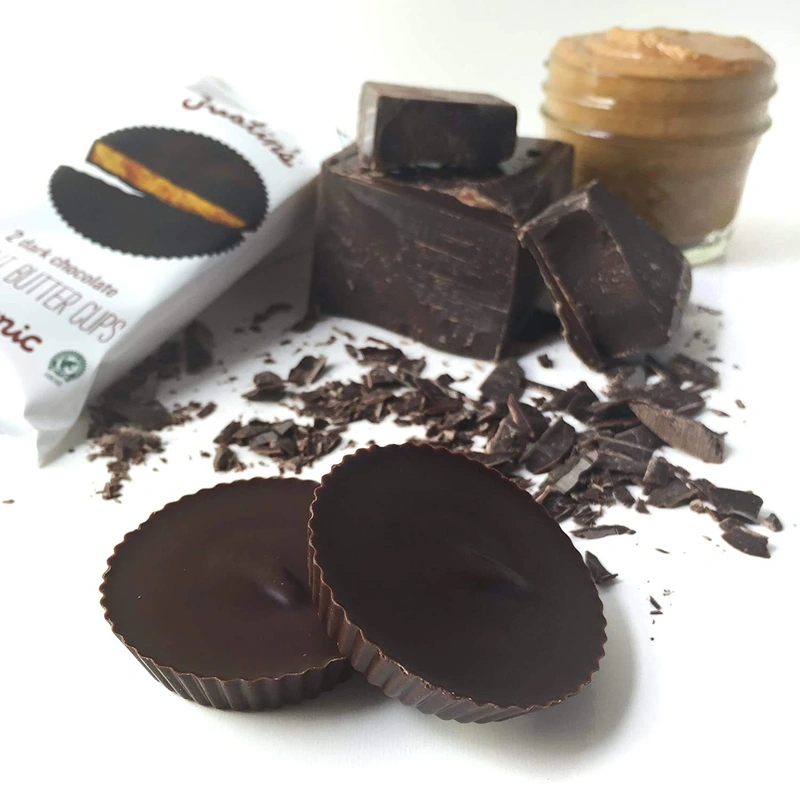
Almond butter gives the cup a different nutty center from the peanut minis. The larger format leaves room for several bites through the chocolate and filling, with two cups in the packet.
View on AmazonThese cups make sense when almond is the ingredient you are craving. The filling brings the nut into the middle as a butter, giving you a continuous almond-and-chocolate bite instead of the scattered crunch of chopped almonds in a solid bar.
The distinction from the peanut minis is both the nut and the size. Each almond cup averages 20 g, so one is a more substantial sweet. The complete 40 g packet can be shared between two people, or enjoyed as a pair; opening one packet does not produce a large bowl of loose chocolates.
Give the almond filling a simple companion
An unsweetened coffee is a straightforward pairing for a sweet nut butter cup. A milk coffee softens the overall combination, while a plain black tea lets the chocolate remain the richer part of the break. There is little need to add almond syrup to the drink just because almond is in the sweet.
I prefer this format for a focused almond-and-dark-chocolate treat, rather than an assortment for a table of different tastes. Two matching cups offer a clear pleasure, but they do not give two people a choice of fillings. That is a reason to choose Merci for a group, not a shortcoming of the almond cup itself.
The current recipe combines almonds with sugar, almond protein, palm oil and sea salt within dark chocolate. Those supporting ingredients help make a confectionery filling; it is not simply a spoonful of unsweetened almond butter under a shell. Choose it for almond in chocolate, not for a plain-nut snack.
For somebody who enjoys cashew instead, the next packet offers the same two-cup size with a different nut at its heart.
Justin’s Dark Chocolate Cashew Butter Cups
A creamy cashew center in a dark shell.
Organic cashew butter filling in two dark chocolate cups. One 1.4 oz / 40 g packet.
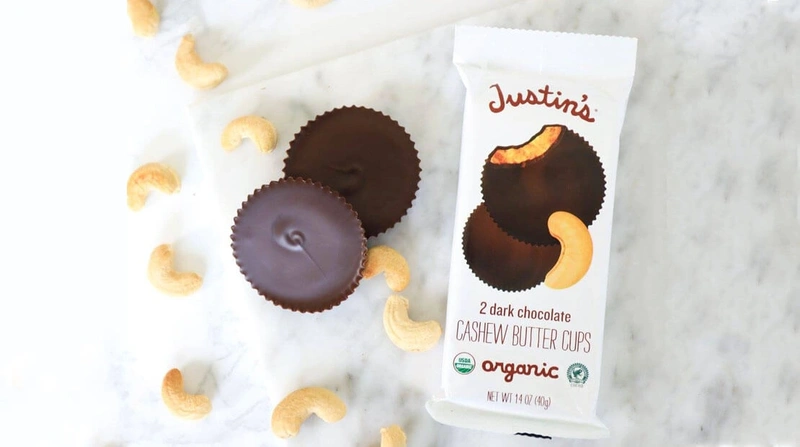
Cashew changes the nut at the heart of the cup. The same two-cup format is useful when you want to choose by the filling, without changing the size of the treat.
View on AmazonCashew butter brings a creamy nut filling to a substantial dark chocolate cup. It is a good direction for a cashew lover who wants that ingredient inside a sweet, rather than a handful of chocolate-coated whole nuts. The shell and center stay distinct, so the chocolate still has its own part in the bite.
The almond and cashew packets are particularly useful to compare because both contain 40g across two cups. Neither is the larger purchase. The decision can stay with the filling instead of being distracted by different bag sizes or a much bigger supply.
Almond butter cups
A focused choice for somebody who already enjoys almond butter and wants it enclosed in dark chocolate. The filling uses almonds and almond protein.
Cashew butter cups
A change of nut within the same two-cup format. The current filling uses cashews and oat flour alongside sugar, palm oil and sea salt.
That difference matters more than trying to declare one nut universally better. A favorite ingredient is a perfectly good reason to choose one packet. If both sound appealing, sharing one of each gives two people a small comparison without opening several large bags.
The 40 g cashew packet contains 14 g of total sugars, matching the current almond packet. Equal sugar quantities do not mean identical flavors, nor do they tell you which texture you will prefer. The nut and the chocolate remain the more useful starting point.
For a different texture altogether, the next sweet trades nut butter for a whole hazelnut inside a caramel cup.
Toffifee White Chocolate
A whole hazelnut beneath the white chocolate cap.
Caramel cups with a whole hazelnut, light milk cream filling and white chocolate. Fifteen pieces, 125 g.
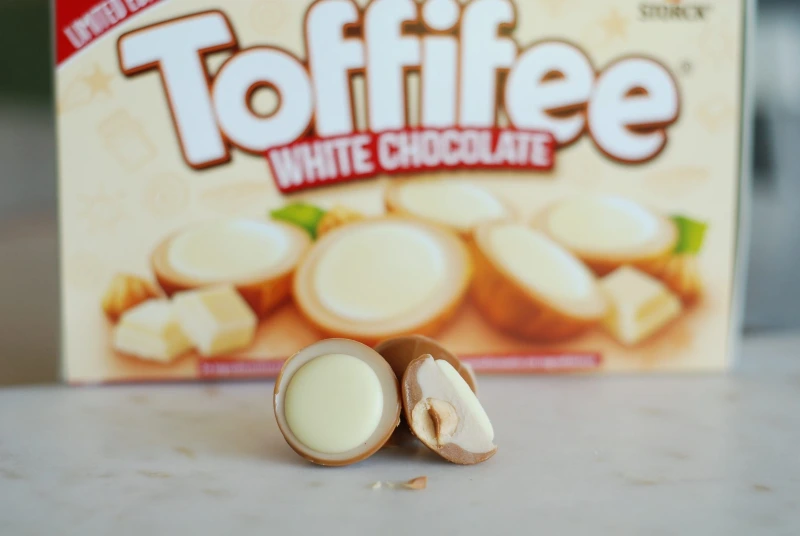
Chewy caramel, smooth cream and a whole hazelnut give this small cup several textures. White chocolate finishes the top, making it a different confection from the original chocolate-capped Toffifee.
View on AmazonToffifee White brings the whole nut back into the bite. The hazelnut sits in a caramel shell with a light cream filling, while the white chocolate cap adds another smooth layer. It is a more playful sequence of textures than the continuous nut butter centers above.
The caramel is part of the cup itself, so there is more chew than in a plain filled chocolate. That makes this an especially appealing choice when you enjoy caramel and hazelnut together. Someone looking only for a soft, melting center will find a different pleasure in the nut butter cups or raspberry square.
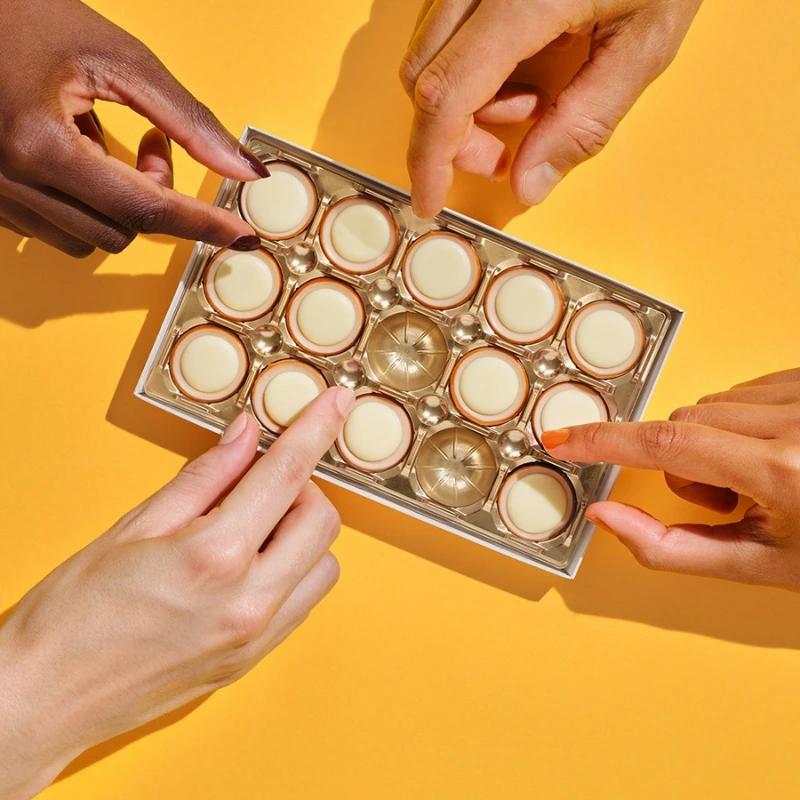
A small tray for a shared sweet course
The 15-piece tray is convenient for a small gathering. Each cup has its own place, and the open tray can be passed around without tipping loose chocolates into a bowl. It feels more like setting out a small sweet course than opening a supply bag.
Each piece averages about 8.3 g, making it the smallest individually measured confection in the comparison below. That is a useful distinction when you want several little tastes over an evening. A small piece still has a whole hazelnut and a caramel shell; the size does not make it a plain chocolate button.
An unsweetened coffee or a plain black tea gives the caramel and white chocolate a welcome contrast. A very sweet milky drink adds sweetness in the same direction. Choose that richer combination deliberately if it is what you enjoy, rather than assuming white chocolate needs an equally sweet companion.
The recipe includes milk, hazelnuts and soy, and the maker also identifies a flavoring containing peanut. It deserves particular care when choosing for somebody with allergies. White chocolate is still chocolate; its pale color says nothing about allergy suitability.
For a softer hazelnut filling with less chew, Hu takes the same nut in a different direction.
Hu Hazelnut Butter Dark Chocolate
Hazelnut in a softer layer.
A 60 g / 2.1 oz dark chocolate bar filled with hazelnut butter.
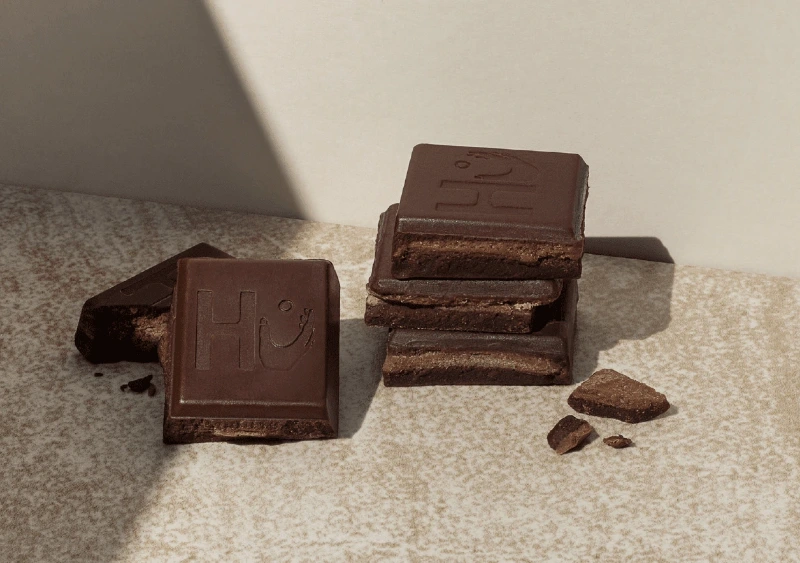
A hazelnut butter layer inside dark chocolate gives Hu a different rhythm from a caramel cup. Break off a square and enjoy the filling without a whole nut or wafer at the center.
View on AmazonHu is the bar for someone who wants to decide how much chocolate to break off. The filling runs beneath the chocolate faces, so a small square brings the same basic contrast as a larger piece. It offers more flexibility than a confection already shaped into one complete cup.
The hazelnut is a butter filling, rather than whole nuts embedded through a solid bar. That gives it a gentler texture than Toffifee White. The chocolate supplies the firmer exterior, and the center stays a separate layer instead of becoming a crunchy inclusion.

A filled square to return to
The 60 g bar is a useful choice for one person or a couple who want a small supply for more than one pause. Break what you want, then wrap the remainder well. It does not need to become a plate of broken pieces just because you have opened it.
With a black coffee, the dark chocolate and hazelnut make a clear pairing. A milk coffee gives the same square a softer setting. Neither needs an elaborate garnish: the visible hazelnut layer already supplies the reason to choose this bar over a plain dark one.
The recipe names cocoa butter and hazelnut butter, with coconut sugar contributing sweetness. It suits the person who specifically wants that combination in a filled bar.
Hu is more personal than a mixed box: there is one filling throughout, and the bar needs breaking and rewrapping. For a bright change from all these nut centers, raspberry offers a different ending.
Ghirardelli Dark Chocolate Raspberry Squares
A fruity center after the nutty ones.
Individually wrapped dark chocolate squares with raspberry filling. One 5.32 oz / 151 g bag.
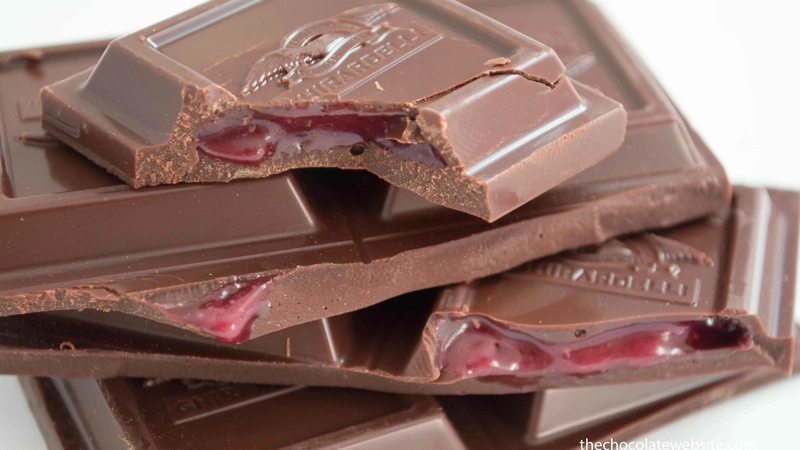
Raspberry filling changes the direction of the sweet, bringing fruit flavor into dark chocolate after the creamier nut choices. The flat wrapped square is easy to save for a small after-dinner treat.
View on AmazonA raspberry-filled square is an appealing change when you want chocolate without another roasted-nut center. The dark shell and sweet, tart filling bring a different balance from peanut butter or caramel. It is the fruit option in this selection, rather than a fruit-and-nut mixture.
The filling contains raspberry powder within a sweet confectionery center. It is not a whole raspberry dipped in chocolate. That distinction helps set the right expectation: a filled square has a soft, concentrated middle and a defined chocolate exterior, rather than the texture of fresh fruit.

A bright finish without another dessert plate
The individually wrapped format is useful after dinner. Put a few squares beside the cups and leave the rest in the bag. A square feels like a complete small chocolate, so there is no bar to divide or open assortment to keep explaining.
The 151 g bag offers several future pauses without the quantity of a large sharing box. It is a single recipe throughout, so it makes more sense for somebody who already likes raspberry in chocolate than for a group looking for many different centers.
For a cup alongside it, a plain black tea is an uncomplicated choice. Coffee gives the dark chocolate a roasted companion while the fruit provides the contrast. After a nut butter cup, a raspberry square can also be the change that makes a small selection feel varied without adding more nut recipes.
Dark chocolate does not establish that this recipe is dairy-free: milk fat and soy appear in its ingredient information. Keep that distinction when choosing for somebody else. The reason to reach for this square is its raspberry-and-dark-chocolate pairing, with a soft filling that stands apart from the other six choices.
Which center belongs in your evening?
The differences are easier to enjoy when you keep filling, texture and quantity as separate decisions. A bigger bag does not make a creamier chocolate, and a darker shell does not tell you what is waiting inside.
| The chocolate | The center | The bite | The whole purchase | Especially appealing for |
|---|---|---|---|---|
 Merci Finest Assortment | Mixed specialtiesFilled and plain recipes | Varies by finger | 250 g box8.8 oz; individually wrapped | Sharing several chocolate flavors |
 Justin’s Mini Dark Peanut Butter | Peanut butter | Dark shell; dense filling | 133 g bag4.7 oz; mini cups | A small peanut-and-chocolate treat |
 Justin’s Dark Almond Butter | Almond butter | Dark chocolate around a nut filling | Two cups; 40 g1.4 oz packet | A focused almond choice |
 Justin’s Dark Cashew Butter | Cashew butter | Dark chocolate around a creamy center | Two cups; 40 g1.4 oz packet | Cashew in the same two-cup size |
 Toffifee White | Hazelnut and milk cream | Caramel chew; nut crunchWhite chocolate cap | 15 pieces; 125 g | Several textures in a small caramel cup |
 Hu Hazelnut Butter | Hazelnut butter layer | Dark chocolate; no whole-nut center | One 60 g bar2.1 oz; break into squares | Choosing the size of each piece |
 Ghirardelli Dark Raspberry | Raspberry filling | Dark shell; soft fruit center | 151 g bag5.32 oz; wrapped squares | A fruity change from nut fillings |
A little cup and a larger cup are different treats
Toffifee White averages about 8.3 g per piece. A Justin’s mini peanut butter cup averages 12 g, while an almond or cashew cup averages 20 g. One piece is not a common portion size across the selection. The larger cups are better suited to several bites; the smaller caramel cup brings its own chew and crunch in less weight.
Average weight per piece (g)
How much does one cup weigh?
These are average weights derived from the maker’s piece or pack information. They are useful for imagining the size of the sweet, rather than prescribing how many to eat. Hu is left out because the piece you break off is up to you, and the assorted and raspberry products are not assigned an unverified uniform piece weight.
Compare sugar on the same basis
The current maker figures give 9 g of total sugars in 24 g of Justin’s mini dark peanut butter cups, and 14 g in each 40 g almond or cashew packet. Toffifee White lists 46.5 g per 100 g. Converting the cup figures to the same 100g basis makes the comparison meaningful.
Total sugars per 100 g
How do the sugar quantities compare at equal weight?
This common weight is a comparison basis, not a suggested serving. The almond and cashew recipes have the same sugar quantity on these labels, but remain different nut fillings. The figures also cannot predict sweetness on their own: chocolate, salt, nuts and caramel all contribute to how a confection comes together. No average has been invented for the mixed Merci box.
How much chocolate are you opening?
The two Justin’s packets are the smallest complete purchases here. Hu gives you a bar to revisit, while the bags and Merci box offer more for sharing or several evenings. Think about the whole amount as well as the size of an individual sweet.
Net weight of the complete purchase (g)
How much is in the complete purchase?
A 250 g assortment is useful when several people want a choice. A 40 g packet is more focused when you already know the filling you want. Neither is inherently more generous: the useful quantity is the one that fits the occasion and leaves you looking forward to the next piece.
Make a small selection worth lingering over
A pleasing chocolate plate needs contrast more than quantity. Start with one favorite filling and add one clear change: fruit after nuts, caramel after a soft center, or a mixed box when nobody wants the same thing.
For two people with the same favorite
Share the two almond or cashew cups, break a few Hu squares, or put a pair of raspberry chocolates beside the cups. One recipe keeps the choice uncomplicated.
For people who enjoy choosing
Open Merci with its guide, or offer a few Toffifee White cups alongside raspberry squares. The change of texture and filling gives the second sweet a different reason to be there.
For a small nut butter comparison, almond and cashew are especially easy to arrange: the packets contain the same number of cups and the same total weight. Divide one cup of each between two plates if both people want to compare. Keep the packets nearby so the two fillings remain identifiable.
Do not let the most assertive flavor dictate every other choice. Peanut butter has a recognizable roasted character; caramel adds chew and sweetness; raspberry brings a fruit note. Two quite different sweets often make a more satisfying plate than several versions of a flavor you have already had enough of.
A cup that leaves room for the chocolate
An unsweetened coffee is a useful starting point for dark chocolate and nut butter. A milk coffee gives the combination a softer feel. Plain black tea works when you want a familiar, less roasted companion, especially with a raspberry square or a sweeter caramel cup.
Keep the first pairing simple. There is no need for a caramel coffee, hazelnut syrup and a flavored cream when the chocolate already contains a distinctive center. Those combinations can be enjoyable, but they make a different, sweeter dessert. A familiar cup makes it easier to enjoy what attracted you to the chocolate in the first place.
If caffeine is not part of your evening, the sweets still stand on their own. A decaffeinated cup or water leaves the filling and shell as the main pleasure. The chocolate does not need an elaborate drink to become an occasion.
Keep the next piece enjoyable
Set out what you want to eat and protect the remainder from warmth, strong odors and moisture. Keep wrapped pieces wrapped, reseal a bag, and close the box after choosing. A little plate beside a warm cup is more sensible than resting the whole bag against the hot mug.
A warm room can soften chocolate and fillings; a very cold piece can make the shell unusually firm. Follow the storage directions on the package, and avoid repeatedly moving the whole supply between warm and cold places. For a shared evening, bring out a small amount at a time instead of leaving everything beside a heater or sunny window.
For guests, keep the ingredient information available even after transferring sweets to a dish. This selection includes peanuts, several tree nuts, milk and soy across different recipes. Changing the nut or the color of the chocolate does not establish allergy suitability. Avoid mixing unwrapped pieces together when somebody needs to identify ingredients precisely.
The nicest starting choice is the most specific one. Choose the peanut minis for a small peanut butter treat, the almond or cashew packet for that particular nut, and Hu for a bar with a hazelnut layer. Toffifee White supplies caramel and a whole nut; raspberry supplies the fruit change; Merci supplies the choice. Leave enough space in the evening to enjoy the one you actually wanted.
A few questions before the next chocolate
Are all of these truffles?
No. They include nut butter cups, a caramel-and-hazelnut cup, a filled bar, raspberry-filled squares and an assortment of chocolate fingers. A soft middle does not make every chocolate a truffle, and these fillings should not all be described as cream ganache.
Which choice has the least crunch?
Start with a nut butter cup, Hu’s hazelnut layer or a raspberry square if you want a soft center without a whole nut or wafer. The chocolate shell still has its own firmness. Toffifee White is the clearest choice here for a whole-hazelnut crunch and caramel chew.
Is dark chocolate automatically dairy-free?
No. Dark chocolate describes the chocolate style, not a universal allergen guarantee. The Ghirardelli raspberry recipe includes milk fat, and other products can carry shared-equipment warnings. Use the complete current label for the exact sweet when dairy avoidance matters.
Can a nut butter cup replace the caramel cup on a small plate?
Yes, if the person prefers a yielding nut center to caramel chew and a whole hazelnut. The larger almond and cashew cups are more substantial than a Toffifee White piece, so they change the amount as well as the texture. Neither format is an automatic dietary substitute for the other.
Which is easiest to share without opening a large supply?
The 40 g almond and cashew packets each contain two cups, making them straightforward for two people who like the same filling. For a group wanting variety, the 250 g Merci assortment is more useful. A bag of raspberry squares works when everybody is happy with one fruit-and-chocolate recipe.